



Behind the Wings ®
The Podcast – S7, Episode 70
Get an inside look at NASA’s Quesst mission and the effort to bring supersonic flight back over land, without the disruptive sonic boom.
Listen Anywhere! Apple | Spotify | All Players
For more than 50 years, civil aircraft in the U.S. have been effectively barred from flying supersonic over land, not because of speed, but because of noise. NASA aims to change that paradigm with the X-59, a purpose-built experimental X-plane designed to reshape shockwaves so they reach the ground as a quiet “sonic thump” rather than a window-rattling boom.
In this episode, Host Rick Crandall is joined by Cathy Bahm, Low Boom Flight Demonstrator Project Manager at NASA Armstrong, who leads the design, build, and flight test progression of the X-59, and Lori Ozoroski, Commercial Supersonic Technology Project Manager at NASA, who oversees mission planning, acoustic validation, community response testing, and how that data is delivered to regulators.
- Today’s airliners cruise around Mach 0.85. A future quiet-supersonic aircraft could cruise around Mach 1.4, potentially cutting long trips dramatically (for example: Los Angeles–New York ~3 hours, Los Angeles–Paris ~6.5 hours).
- Manufacturers may be unwilling to “cut metal” on new supersonic airliners until certification requirements are defined. Quesst is designed to provide the evidence regulators need to set those requirements.
- This is high-risk, public-benefit work that’s difficult for a single company to justify alone. NASA’s research is risk reduction for the wider aerospace community.
The Big Picture:
NASA’s plan is straightforward:
- Design a jet that reshapes shockwaves so the ground hears a softer “thump,” not a sharp boom.
- Measure the sound precisely using airborne and ground systems to validate predictions.
- Fly over communities and collect survey feedback on the sound.
- Deliver data to regulators (U.S. and international) to inform future standards for overland supersonic flight.
The X-59 is the centerpiece, built to generate real-world data, not to become a commercial airplane itself.

What is the X-59:
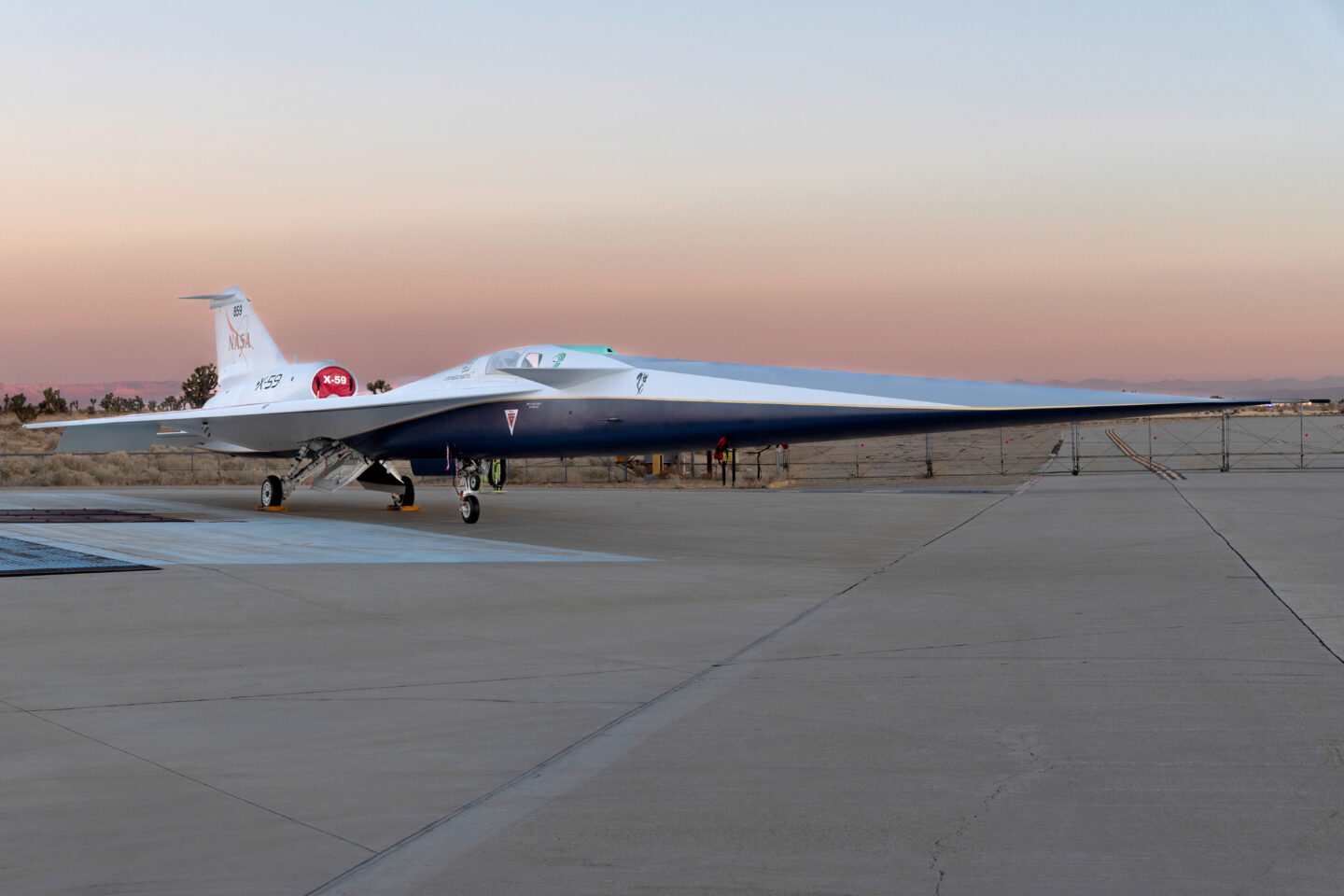
The X-59 is NASA’s quiet-supersonic X-plane (a low-boom flight demonstrator) built to study how aircraft shape can reduce sonic boom loudness.
Why does it look unusual:
- The aircraft is almost 100 feet long, and about one-third of it is the nose. That gradual shaping helps prevent shockwaves from piling into one strong wave.
- The engine is mounted above the wing, helping reduce shockwave energy directed toward the ground.
- A distinctive tail configuration helps “tune” shockwaves from the aft end of the aircraft.
NASA’s team often describes it this way: the X-59’s exact silhouette won’t be copied into future airliners, but its design DNA (long, carefully shaped volume distribution and shock control) is expected to show up in next-generation supersonic designs.

How a Sonic Boom Forms:
When an aircraft flies subsonically, pressure disturbances can move ahead of the aircraft. When it flies supersonic, the aircraft outruns those disturbances. Pressure changes stack into shockwaves that travel to the ground and can be heard as a boom.
The X-59’s goal is to spread and shape those pressure changes so they don’t “pile up” into one strong shock front. Instead of a sharp boom, the target is a quieter, less startling sound, often described as more like a soft thump, no louder than a car door closing.
Acoustic Validation:
Before flying over communities, NASA needs to confirm that the X-59 is creating the shockwave pattern it was designed to produce, and prediction tools match measured reality (so the team can avoid “surprises” in later public flights). NASA measures “quiet” by using:
- Chase aircraft (described in the episode as an F-15 with a shock-sensing probe) to measure shock structure near the X-59.
- NASA’s Ground Recording System (GRS), which is a portable, deployable acoustic recording network built to capture sonic boom signatures with the resolution and dynamic range needed for policy-grade analysis.
- Atmospheric measurements since weather strongly affects what reaches the ground. Key variables discussed include temperature, turbulence, and humidity.
How the Pilot Sees:
Because the nose is so long, the X-59 doesn’t use a conventional forward-facing cockpit window. It uses two systems:
- The External Vision System (XVS) is a camera that brings a forward view into the cockpit on a high-definition display.
- The Forward Vision System is used for low-altitude operations (including landing), providing visibility beneath the nose.

Community Response Testing:
Once NASA completes the needed flight envelope work and acoustic validation, the mission transitions to human response data. This pivotal step is often the primary influence on regulatory changes.
The Test Plan:
- The X-59 flies planned passes designed to create a range of ground sound levels.
- Communities are informed of the study and participate through structured surveys measuring perceived loudness and annoyance.
- NASA is carefully choosing communities to test with. They will require factors such as: location, type of neighborhood, climate zones, nearby construction, typical window-open/closed behavior, and areas further away from airports.
- The goal is to create a dataset representative enough to support U.S. and international regulatory decisions.
What Changes if Quesst Succeeds:
NASA’s stated sequence is: deliver data to the FAA and to international regulatory bodies, which will use it to define acceptable overland supersonic noise limits, and how future aircraft would be certified against those limits. Only then can you expect commercial programs to accelerate with lower risk.

FAQ:
Is NASA trying to bring back Concorde?
Not directly. Quesst is focused on noise (community acceptability) and the data needed for future rules—not reviving a specific commercial aircraft.
Will the X-59 carry passengers?
No. It’s a research X-plane built for flight demonstration and measurement.
Why does the weather matter so much?
Atmospheric conditions (especially humidity, turbulence, and temperature) can change how shockwaves propagate from altitude to the ground. NASA measures weather carefully to interpret results and plan safe, predictable test passes.
Go Deeper:
Want more Behind the Wings?
Peek into the cockpits of rare warbirds and spacecraft, hear from aerospace experts and more in our episodic documentary series!
Learn more