

Leadership Under Pressure – S8, Episode 72
Retired Major General John Barry shares his story of surviving the 9/11 attack on the Pentagon and the chaos that followed.
Listen Anywhere! Apple | Spotify | All Players
In this episode, Host Rick Crandall talks with John, the former CEO of Wings Over the Rockies and a retired U.S. Air Force fighter pilot whose career spans Cold War operations, combat command, NASA crisis response, and leading the largest fighter wing in the world at Luke Air Force Base. This one is going to be cool!

The Big Picture:
John Barry’s career moved through nearly every level of military aviation and aerospace leadership. He flew NATO Cold War alert missions in Europe, sat on nuclear alert in Germany, helped develop tactics at Nellis Air Force Base, commanded combat operations from Turkey, led the massive F-16 training enterprise at Luke Air Force Base, survived the attack on the Pentagon during 9/11, and served on the investigation board for the Space Shuttle Columbia disaster.
From flying the F-4 Phantom and F-16 Fighting Falcon to helping investigate both the Challenger and Columbia shuttle disasters, Barry’s career placed him inside some of the most consequential moments in modern aerospace history. Beyond airplanes, his stories provide insights into leadership, accountability, and making high-stakes decisions.
Across all of it, his leadership philosophy remained consistent: “Make it better than you found it.”

The McDonnell Douglas F-4 Phantom II:
Originally designed for the U.S. Navy as a fleet defense interceptor, the Phantom was built for speed, range, and heavy missile capability. It was a tandem two-seat, twin-engine, all-weather aircraft with a large radar and the ability to carry a massive weapons load at fighter speeds. It could exceed Mach 2.2, climb at more than 41,000 feet per minute, and carry more than 18,000 pounds of weapons across nine external hardpoints.
Its original concept reflected Cold War doctrine: radar-guided missiles, beyond-visual-range engagements, and no internal gun. The assumption was that future air combat would happen at speed and distance, not in close-range dogfights. Vietnam proved otherwise.
Rules of engagement often required visual identification, forcing pilots into close-range fights where early missiles were sometimes unreliable, and the lack of a gun became a serious weakness. Many pilots found themselves directly behind enemy aircraft with no effective shots available. The Air Force first added external gun pods, then permanently solved the problem with the F-4E variant by installing the internal M61 Vulcan 20mm cannon.
Barry loved the airplane because it could do everything: “It’s air-to-air, air-to-ground, nuclear. It really was the weapon at the time.”
The F-4 helped shape Red Flag, Top Gun, and modern fighter doctrine by proving that training, adaptability, and a diverse toolkit were critical while forcing the U.S. military to rethink how air combat was fought.

John’s Backstory:
Barry grew up in New York City and found his path to the Air Force Academy thanks to a girl he was dating at the time. He entered in 1969 and graduated in 1973 during the Vietnam War era, fully aware that military service would likely mean immediate operational responsibility.
Notably, during his time at the Academy’s soaring program, where he served as a glider instructor, another instructor in his class was Chesley “Sully” Sullenberger, long before the Hudson River landing made him famous. Beyond flight training, the Academy shaped the leadership principles that would define the rest of his career.
NATO Alert:
Instead of deploying to Thailand as the Vietnam War wound down, John was assigned to Soesterberg Air Base in the Netherlands with the 32nd Fighter Squadron. There, he sat Zulu Alert as part of NATO’s Cold War air defense mission.
As Barry describes it: “You’re airborne in five minutes, you’re supersonic in seven minutes from a dead sleep.”
East German aircraft would periodically test NATO responses near the border. Pilots had to launch, identify the aircraft, and be prepared to engage if necessary. One night, Barry was cleared “hot” and authorized to fire. He closed to missile range and waited for final clearance before being told to abort. The target turned out to be a West German F-104 that had lost electrical systems in poor weather.
That moment became one of the most important lessons of his career: never rush target identification. Years later, flying over Iraq, that same lesson helped prevent a friendly-fire incident.
Why Pilots Needed Eye Patches:
Barry later transferred to Ramstein Air Base in Germany, where he moved from air defense alert to nuclear alert, known as Victor Alert. His F-4 carried the B61 nuclear weapon, and pilots had to brief their mission directly to senior commanders before being certified. Once approved, they were issued an eye patch.
If nuclear detonations occurred ahead of their aircraft, pilots risked flash blindness from the blast. The eye patch protected one eye so they could still fly. It was a practical reminder of how serious the Cold War was.

Nellis Air Force Base, Red Flag, and Constant Peg:
At Nellis, John attended Weapons School and later served in the 422nd Test and Evaluation Squadron, helping test new tactics and weapons systems. This included working on laser-guided bombs, AIM-7 and AIM-9 missiles, and integrating aircraft such as the F-15, F-16, A-10, and F-4 into a new combat doctrine. The work directly shaped tactics later used successfully during the Gulf War.
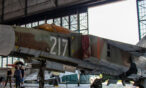
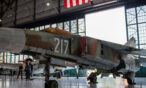
He also participated in Red Flag, the Air Force’s advanced combat training program. The idea was that if pilots could survive their first ten combat missions in training, they were far more likely to survive the real thing. Barry also flew against MiG aircraft through Project Constant Peg, a classified program where American pilots trained alongside Soviet-designed aircraft, including MiG-17s, 19s, 21s, and 23s.
Commanding Luke Air Force Base:
John went on to command the largest fighter wing in the world at Luke Air Force Base. The scale was enormous: 202 F-16s, 27 squadrons, and roughly 20,000 personnel.
Because Luke was a training base, its aircraft flew harder than most operational fleets. Student pilots pushed the jets to their limits daily, which meant maintenance issues showed up there first. One major problem involved afterburner cans on Pratt & Whitney engines cracking and peeling apart, causing pilots to lose thrust and eject. After multiple incidents, Barry called what he described as an “engine summit” and demanded that every expert involved attend.
The recommendation was to inspect a suspect production lot. He went further and ordered inspections outside that lot, making it clear that if cracks were found, he would ground the entire wing. When they found multiple issues, he pulled every engine, and the resulting inspection exposed problems across the wider fleet. The maintenance teams worked around the clock, and the fix led to an Air Force-wide technical change that likely prevented future losses.
Inside the Pentagon on 9/11:
On September 11, 2001, John was working inside the Pentagon at his desk. He heard about the first tower strike in New York and, like many people, initially assumed it was an accident. The second strike made it clear it was not. At 9:37 a.m., Flight 77 hit the Pentagon.
Barry’s office was two sections away from the impact. During evacuation, he checked every area under his responsibility and found a woman frozen under her desk, too frightened to move. He and another officer carried her down five flights of stairs to the medical teams. The building burned for ten days.
The plane hit the recently renovated section. Had it struck another side facing the Potomac, much of the Pentagon’s senior military and civilian leadership could have been lost at once.

Investigating the Space Shuttle Columbia Disaster:
In 2003, John was asked to help investigate the Columbia accident. The technical cause was from foam striking the wing during launch, allowing superheated plasma to penetrate while reentering the atmosphere.
But Barry says there were really two causes, the second focused on organizational culture and management. When astronaut Sally Ride was asked what she thought during the investigation, her answer was simple: “I hear echoes of Challenger.”
The board issued 29 recommendations. Fifteen technical fixes were required before return to flight, and fourteen more focused on management and culture.
The Takeaway:
Leadership rarely follows a similar path. Through John’s teachings, we can learn that every opportunity is valuable, even if it doesn’t seem like the right fit at the right time. As Barry says, “Never turn down a phone call, lunch, or a new experience.”

Frequently Asked Questions:
What is Red Flag?
Red Flag is an advanced combat training run by the U.S. Air Force at Nellis Air Force Base. It simulates real conditions so pilots can gain experience before deployment.
What was Project Constant Peg?
It was a classified U.S. Air Force program where American pilots trained against real Soviet-designed MiG fighters to better prepare for combat.
Why was the Columbia disaster so significant?
The Space Shuttle Columbia disaster was hugely important because it exposed critical weaknesses in both spacecraft safety and decision-making culture. Beyond the tragic loss of the crew, it led to major changes in how risks are evaluated, communicated, and managed, reshaping human spaceflight safety moving forward.
Why does Luke Air Force Base have the largest U.S. fighter fleet?
Luke Air Force Base has the largest U.S. fighter fleet because it serves as a primary training hub for pilots flying the F-16 Fighting Falcon and F-35 Lightning II. Its mission requires a high number of aircraft to support continuous training for both U.S. and allied pilots, ensuring readiness across a global force.
Go Deeper:
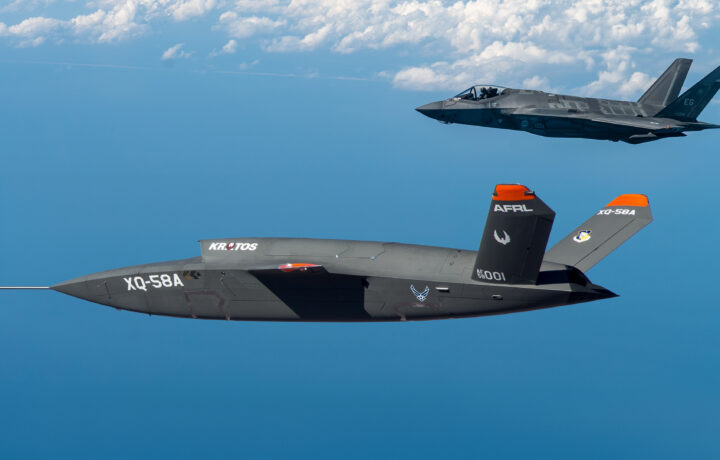
Want more Behind the Wings?
Peek into the cockpits of rare warbirds and spacecraft, hear from aerospace experts and more in our episodic documentary series!
Learn more