What was the F-105 designed to do?
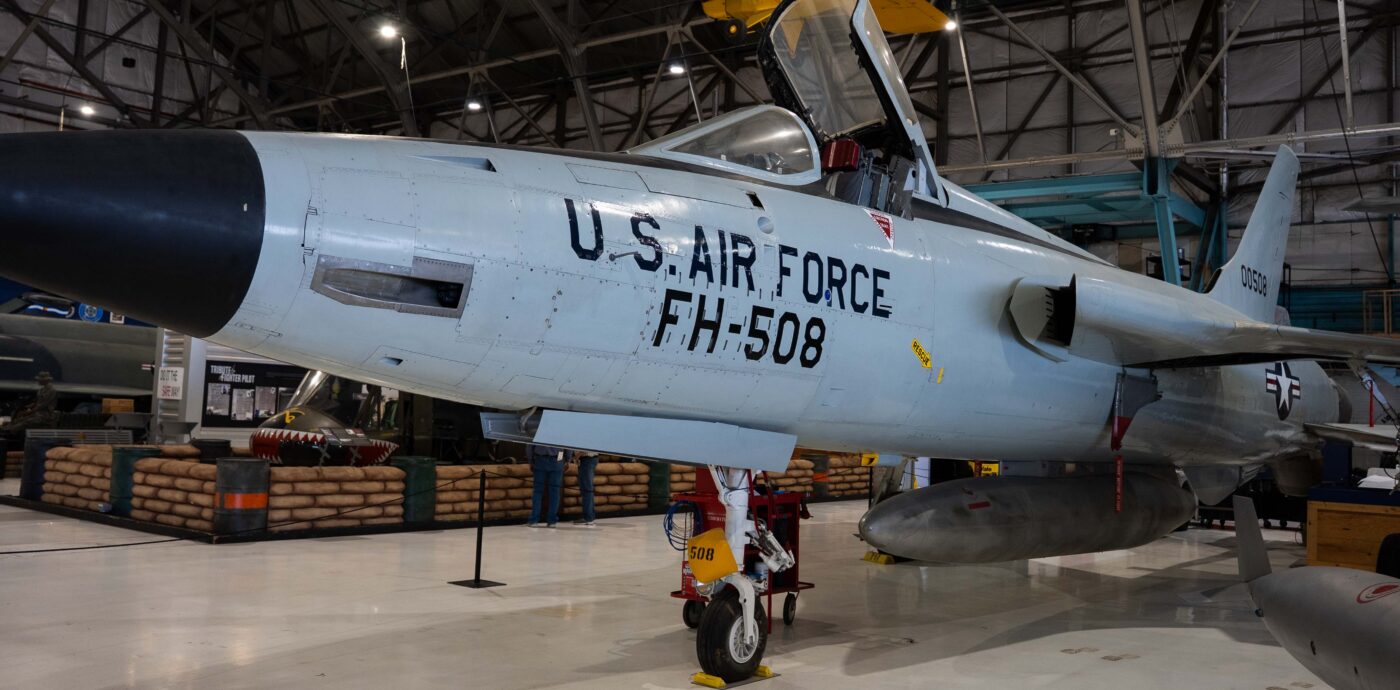
The F-105 was originally designed during the Cold War as a high-speed tactical fighter-bomber capable of invading enemy territory and delivering a nuclear weapon. Its mission changed significantly when it became one of the Air Force’s primary conventional strike aircraft.
Why was the Pratt & Whitney J75 engine so powerful?
The F-105D used a single Pratt & Whitney J75 turbojet capable of producing more than 26,000 pounds of thrust with afterburner. That power helped the large, heavily loaded Thunderchief reach speeds of roughly Mach 2.1 at altitude, making it one of the fastest strike aircraft of its era.
What was a Wild Weasel?
Wild Weasel crews specialized in finding and attacking enemy surface-to-air missiles and radar sites. Two-seat F-105F and F-105G aircraft carried a pilot and an electronic warfare officer, who worked together to detect, locate and attack enemy radar systems.
How did the F-105 compare with the F-4 Phantom II?
Both aircraft became important during the Vietnam War, but they were designed for different missions. The F-105 was used primarily as a high-speed nuclear strike aircraft and became a major conventional bomber over North Vietnam. The F-4 was originally developed as a fleet-defense fighter and evolved into a versatile multirole aircraft used for air-to-air combat, ground attack and other missions. As the war continued, the Phantom gradually assumed many missions previously flown by the Thud.
Did the Thunderchief ever serve with the Thunderbirds?
Yes, the U.S. Air Force Thunderbirds briefly flew the F-105B in 1964. The team performed only six demonstrations with the Thud before returning to the F-100 Super Sabre, giving the F-105 a particularly short chapter in Thunderbird history.




 Air & Space Museum