Air & Space Museum

The Thunderbird F-16D

The Thunderbird F-16D

View Aviation Restoration in Progress!

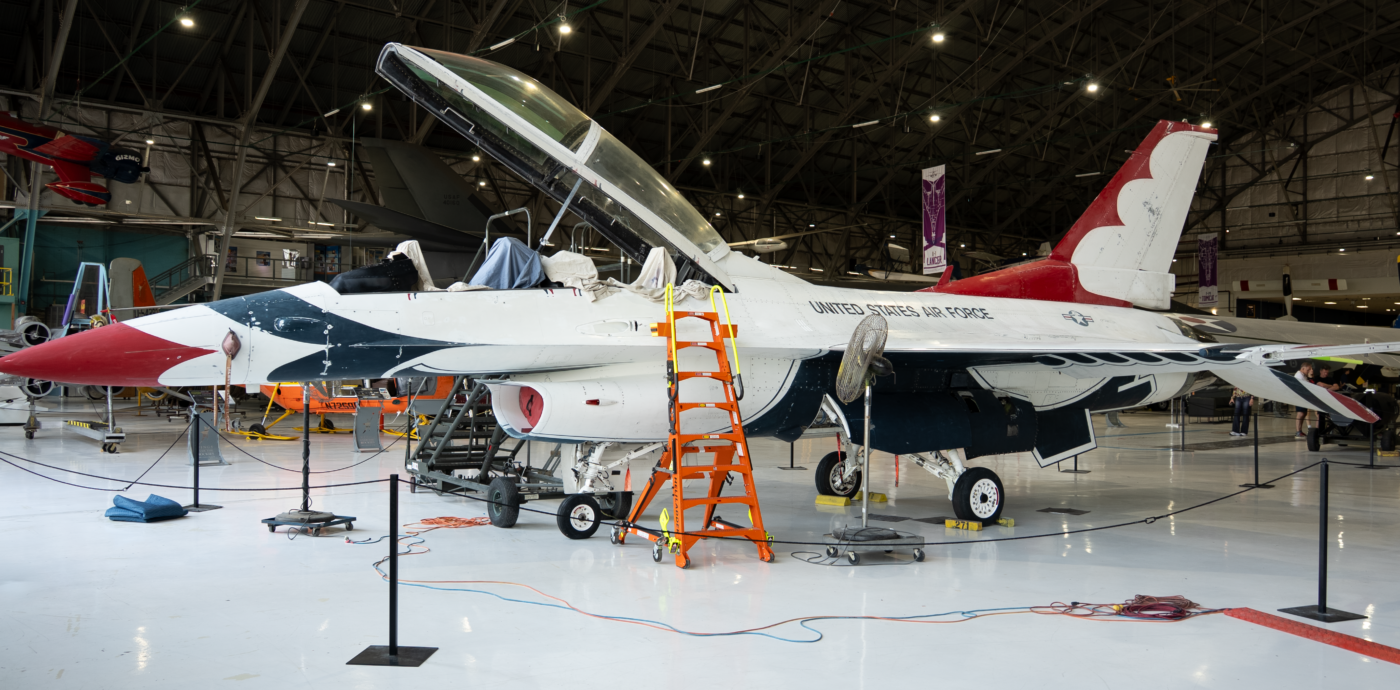
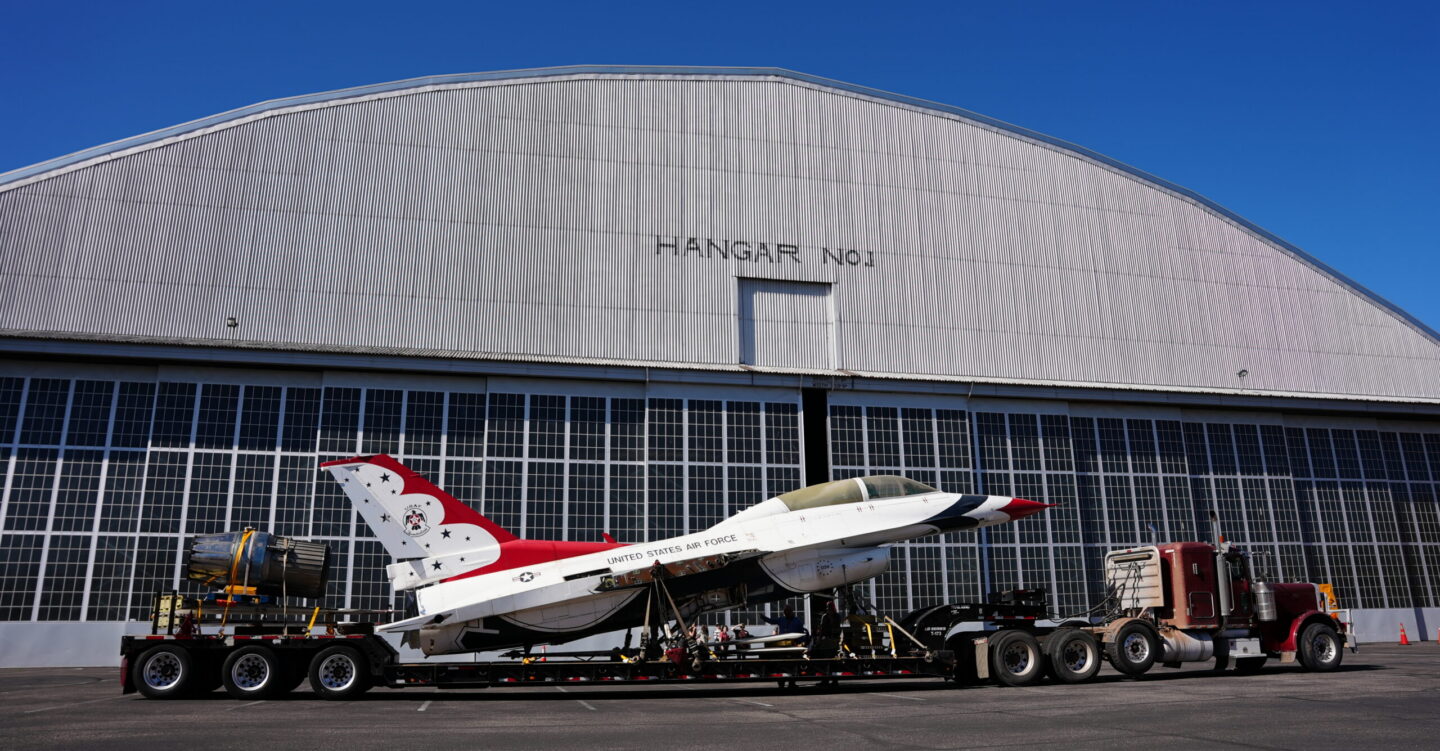
Wings Over the Rockies® is restoring an authentic U.S. Air Force Thunderbirds F-16D to the red, white, and blue appearance it wore during the aircraft’s service with the iconic demonstration team. Our jet is undergoing a complete cosmetic restoration to bring back the legendary livery seen by millions of spectators across the country. 

Unlike most museum restorations that happen behind closed doors, this project is taking place in full view of our guests. Depending on the stage, guests may see volunteers preparing surfaces, applying markings, and completing the details required to recreate the Thunderbirds’ appearance. Every phase offers a unique behind-the-scenes look at the craftsmanship, research, and dedication required to preserve aviation history. 

The completed Thunderbirds F-16D will make its official debut during Wings Over the Rockies’ Spreading Wings Gala this October before becoming a special part of the Museum’s collection. 

If you love the Fighting Falcon, then don’t miss out on this unique opportunity to follow the restoration process and watch history take shape, one step at a time. 

Free Form Image

The Viper’s Legacy

The General Dynamics F-16 Fighting Falcon first flew in 1974 after winning the U.S. Air Force’s Lightweight Fighter competition. Originally designed as a highly maneuverable daytime air superiority fighter, the F-16 quickly proved adaptable enough to perform a wide variety of missions, including air-to-air combat, close air support, suppression of enemy air defenses, reconnaissance, and precision strike operations. This jet entered operational service with the U.S. Air Force in 1978. 

One of the F-16’s most recognizable features is its blended wing and fuselage design, which provides exceptional maneuverability while reducing drag. It also introduced several innovations, including a frameless bubble canopy for improved visibility, a side-mounted control stick, and a reclined seat designed to help pilots withstand high G-forces during combat maneuvers. Powered by a single afterburning turbofan engine, the F-16 is capable of speeds exceeding Mach 2 and remains one of the most agile fighter jets ever built. 

More than 4,600 have been built, and approximately 2,800 remain in service across 29 countries. They have participated in military operations around the world and continue to serve in frontline unitswith many expected to fly for decades to come. 

Our F-16’s Story

This F-16D spent years as an operational airplane before becoming a maintenance trainer. Its assignments included the 57th Fighter Weapons Wing at Nellis Air Force Base and the 3246th and 46th Test Wings at Eglin, where aircraft supported weapons and systems testing. It later returned to Nellis with the Viper Aircraft Maintenance Organization, supporting the aggressor mission and realistic air-combat training. From July 30, 2003, through early 2010, it served with the U.S. Air Force Thunderbirds, whose precision demonstrations showcase the capabilities and the skill of the airmen who fly and maintain it. The aircraft then moved to Sheppard Air Force Base, where the 362nd Training Squadron officially accepted it in June 2010 for hands-on maintenance instruction. After helping generations of airmen learn to inspect, troubleshoot, and repair the jet, it was declared surplus to the squadron’s needs on June 16, 2024. 

After it retired from military service, this F-16 was acquired by Wings Over the Rockies, where it is currently undergoing restoration by the museum’s volunteer team. Once complete, it will help tell the story of one of the most influential and widely operated fighter aircraft of the modern era while honoring the pilots, maintainers, and support personnel who have kept the Fighting Falcon flying for nearly five decades. 

Aircraft specifications: 

Wingspan: 31 ft (9.45 m)
Length: 49 ft 5 in (15.06 m)
Maximum speed: Mach 2.0 (approximately 1,500 mph; 2,414 km/h at altitude)
Maximum takeoff weight: 42,300 lb (19,187 kg)
Crew: One or two, depending on variant (this aircraft: two)
Powerplant: One Pratt & Whitney F100 or General Electric F110 afterburning turbofan engine 

Buy Tickets to See the Viper
Frequently Asked Questions

When did this aircraft serve with the Thunderbirds? 

This jet joined the Thunderbirds on October 19, 2000, and remained with the team until early 2010. 

Why build a two-seat F-16? 

The F-16D is the two-person version of the F-16C Fighting Falcon. Its tandem cockpits allow an instructor, evaluator, observer, or passenger to sit behind the pilot.  

The second seat provides the Thunderbirds with the ability to conduct familiarization and orientation flights for Air Force personnel, community representatives, and other approved guests. These rides offer a firsthand look at the Viper’s performance and the preparation required for the Thunderbirds’ mission. Orientation flights are separate from the team’s official aerial demonstrations. Although commonly used for training, the F-16D is a fully operational, combat-capable aircraft. 

Are Thunderbirds still combat aircraft? 

Yes, Thunderbirds receive a smoke-generating system and the team’s distinctive red, white, and blue paint scheme, but they remain operational fighters. The Air Force has stated that the aircraft can be returned to combat configuration in less than 72 hours if required. 

How fast and maneuverable is it? 

The Fighting Falcon can reach approximately 1,500 mph, or Mach 2 at altitude, and fly above 50,000 feet. Its computer-controlled fly-by-wire system, side-mounted control stick, and aerodynamically unstable design give it exceptional agility. With a full load of internal fuel, the aircraft can withstand turns producing up to nine times the force of gravity, or 9-Gs. 

Why is the F-16 called the “Viper”? 

“Fighting Falcon” is the aircraft’s official name, but pilots and maintainers commonly refer to it as the “Viper.” The nickname emerged early in the airplane’s history, inspired by its snake-like appearance and agility, and possibly by the Colonial Viper spacecraft from the television series Battlestar Galactica. We’ll leave that up to you to decide. 

Topics:

Hear More Stories

Get updates and special offers

Sign up for our newsletter, and stay up to date with all of the latest exhibits and events at Wings Over the Rockies.

F-22 on the Tarmac at Exploration of Flight

Plan Your Visit

Air & Space Museum Air & Space Museum
Lowry - Denver

Air & Space Museum